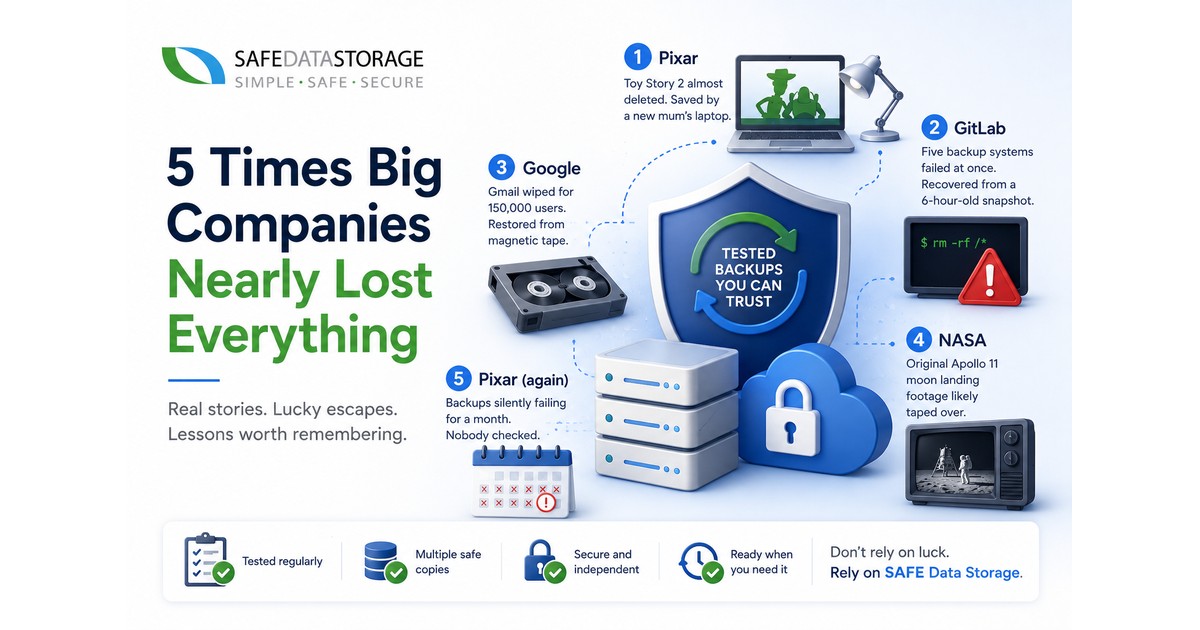
It’s Friday. You’ve earned something lighter than another compliance checklist. So here are five real, well-documented times big, sophisticated organisations nearly lost everything – and the increasingly ridiculous ways they got saved. Consider it a highlights reel of “well, that could have gone better.”
1. The time Pixar accidentally deleted Toy Story 2
In 1998, partway through production, someone at Pixar ran a command that started quietly deleting the film’s files. By the time anyone noticed, around 90% of the movie was gone – characters, sets, animation, all of it. The studio’s backup system, it turned out, had also been silently failing for a month. Toy Story 2 was, for a few hours, mostly not a movie anymore.
It survived because one supervising animator, Galyn Susman, had been working from home after having a baby and happened to have a nearly-complete copy on her home computer. The film that saved Pixar’s second-ever release was rescued by a new mum’s laptop, not a data centre.
2. GitLab’s five backup systems that all failed at once
In 2017, a GitLab engineer, trying to fix a replication lag issue at 11pm, ran a delete command on what he thought was an empty server. It wasn’t. Production database, gone. Not a huge deal, except when the team went to restore from backup, they discovered – in real time, on a livestream, because GitLab does incident response in public – that all five of their backup and replication mechanisms had been silently broken for weeks. They eventually recovered from a snapshot that was six hours old. Everything created or changed in those six hours was gone for good.
GitLab’s own public postmortem is still one of the most refreshingly honest documents in tech. The lesson they drew, in their own words: a backup you haven’t tested restoring is a rumour, not a backup.
3. Google restored Gmail from actual magnetic tape
In 2011, a software bug wiped the entire mailbox history for around 150,000 Gmail accounts – not spam-filtered, not archived, just gone. Google’s fix made headlines for one specific reason: the final safety net wasn’t a server anywhere, it was physical magnetic tape backups, the same technology your dad’s office used in 1985. Even at Google’s scale, the last line of defence was still, essentially, a very large tape drive in a vault.
4. NASA (probably) taped over the original Apollo 11 footage
The clearest video ever recorded of the actual moon landing appears to have been erased. NASA reused a batch of old data tapes in the 1980s – standard practice at the time to save money – and the best evidence suggests the original slow-scan recordings of Neil Armstrong’s first steps were very likely on tapes that got recorded over. The footage we all know is a lower-quality broadcast conversion. The organisation that landed a man on the moon couldn’t produce a receipt for it.
5. Toy Story 2, again, but the boring version
Buried in the Pixar story is the less cinematic root cause: their nightly automated backups had been failing for a month, and nobody had checked. Not a dramatic villain, not a rogue command – just a routine job quietly not working, and nobody finding out until the day it mattered.
The pattern, if you squint
Every one of these organisations had backup systems. Sophisticated ones, in most cases. What went wrong wasn’t a lack of a plan – it was untested backups, single points of failure, or nobody checking that the safety net was actually still there. The businesses that got lucky did so by accident (a laptop, a livestream, a tape vault), not by design.
None of these organisations were small – which is worth remembering if you’re tempted to think backup disasters are a big-company problem. In practice, small and medium businesses and charities are just as exposed, usually with far less IT resource to catch a silent failure before it becomes a real one.
Don’t be the accident. See how SAFE Data Storage keeps a tested, verified copy of your data – the boring, unglamorous kind of backup that means you never need a lucky laptop.