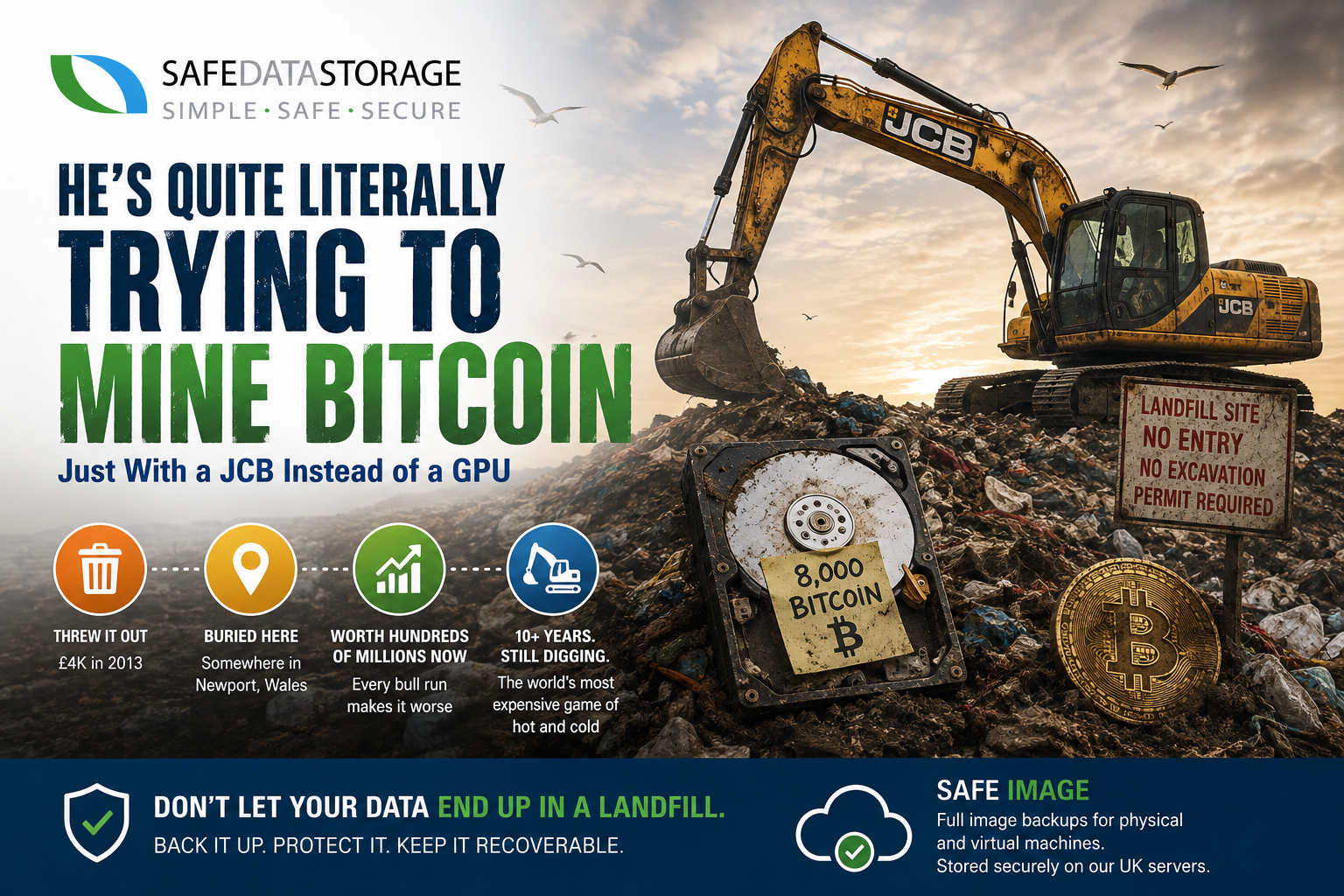
I know this story is a few years old now, but with crypto markets pumping again, it feels more painful (and more relevant) than ever. In 2013, an IT worker in Newport, Wales named James Howells did what most of us have done at some point: he had a clear-out, chucked some old junk, and didn’t think twice about it. Somewhere in that junk was a hard drive holding the private keys to 8,000 bitcoin.
At the time, that was worth about £4,000. Mildly annoying, but the kind of thing you shrug off.
It is currently worth several hundred million pounds. Depending on the day Bitcoin is having, it edges toward a billion. He has spent over a decade fighting his own council for permission to dig up a landfill site the size of several football pitches to try and get it back.
The world’s most literal game of “hot and cold”
Howells knows roughly which section of the landfill the drive is in. He doesn’t know exactly where, because landfills are not neatly organised archives, they are compressed layers of decade-old rubbish, seagulls, and despair. He has offered the council a cut of the proceeds. He has hired engineers. He has proposed ground-penetrating radar, AI-assisted sorting robots, and at one point a full excavation plan with an environmental firm on standby. The council has said no every single time, citing environmental permits and the fact that nobody wants to reopen a landfill for a scavenger hunt.
And here’s the bit that makes this a genuinely Friday-afternoon story: every time Bitcoin pumps, his incentive to dig gets stronger. Which means a rising crypto market is currently motivating a grown man to want to shovel through a Welsh landfill faster.
He is, in a very real sense, digging for Bitcoin. Mining, if you want to call it that, just with a JCB instead of a graphics card.
The maths gets worse for him every single day
Here’s the part that should sting anyone holding crypto right now. That hard drive isn’t sitting still, it’s compounding. Every percentage point Bitcoin climbs, his “backup” (or lack of one) gets more expensive in hindsight. There is no version of this story where time makes James Howells feel better about throwing out that drive. Every bull run is a fresh papercut.
And he is not remotely alone. Chainalysis estimates that around 20% of all Bitcoin ever mined, roughly 3.7 million coins, is permanently lost. Forgotten passwords, corrupted drives, wallets nobody wrote the seed phrase down for, and yes, at least one landfill. At current prices that is a genuinely absurd number, hundreds of billions of dollars sitting in wallets nobody will ever open again, buried, deleted, or simply forgotten. It is arguably the most expensive category of “I’ll back that up later” in human history.
The boring lesson hiding inside a wild story
The frustrating thing about Howells’ situation is how easily it was avoidable. One extra copy of that private key, written on paper and put in a drawer, split across two locations, saved to a second drive, anything, and this is a funny anecdote about an old hard drive rather than a decade-long legal battle with a council over a rubbish tip.
That’s the thing about backups. Nobody plans to need them. The hard drive that gets thrown out, the laptop that gets stolen, the folder that gets deleted by accident, none of it announces itself in advance. The only difference between “amusing story” and “actual catastrophe” is whether a second copy existed somewhere else.
You probably don’t have 8,000 Bitcoin sitting on a single unlabelled hard drive. But if your business has financial records, client files, or anything else that only exists in one place, you are one bad afternoon away from your own smaller, less dramatic landfill story, minus the JCB and the decade of legal letters.
This is exactly what an image backup is built for. Rather than backing up specific files you remember to select, an image backup captures the entire drive, every file, every folder, every wallet.dat sitting quietly in a spot you forgot existed, so nothing gets left behind just because nobody thought to tick the box for it. SAFE Image does exactly that: full disk images of your physical and virtual machines, stored securely on our own UK servers, so a laptop getting wiped, recycled, or accidentally binned doesn’t take anything irreplaceable with it. If Howells had one of those quietly running on that old machine, this would be a very different, and far less painful, story.
Nobody should have to hire an excavation firm to get their own data back.