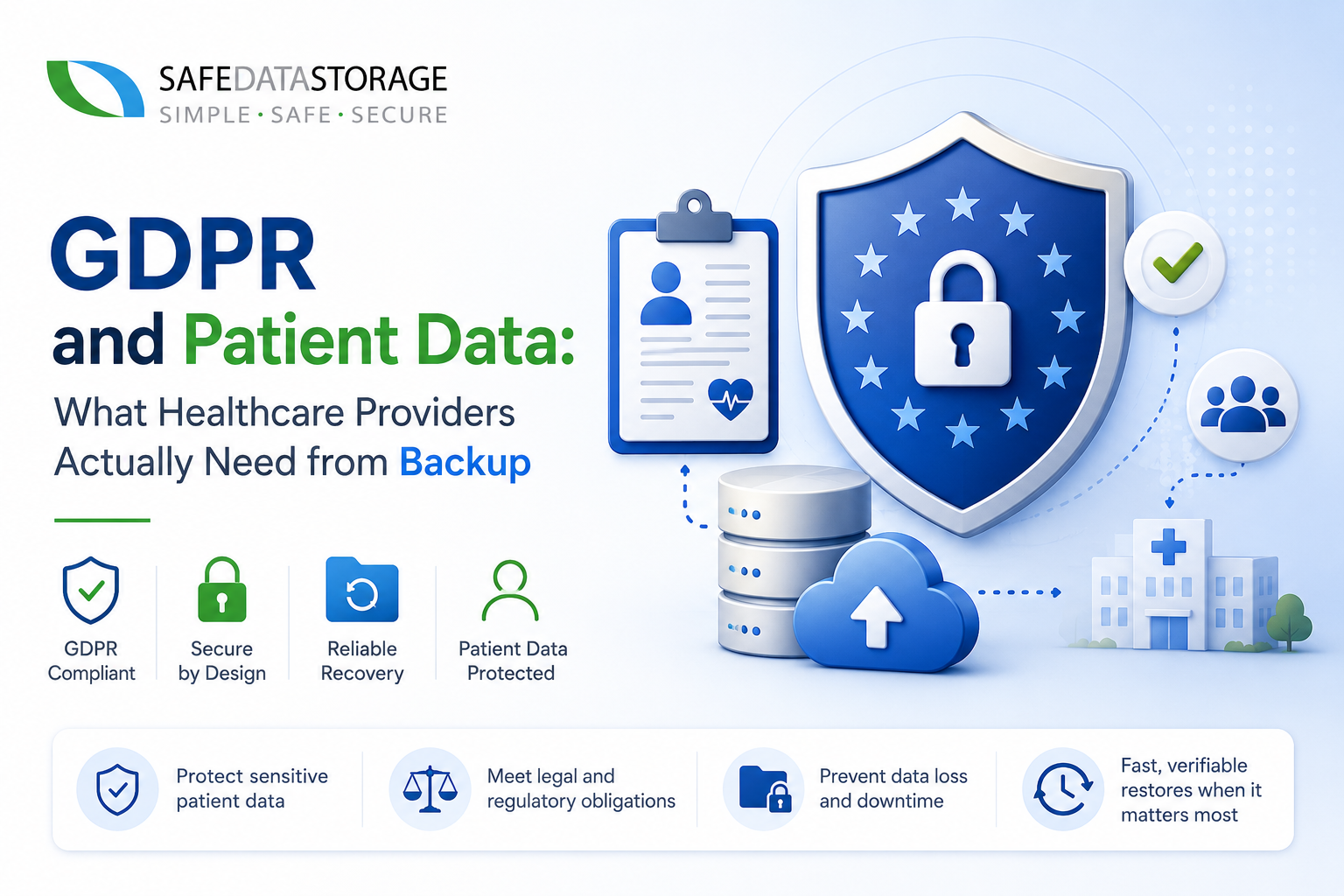
Most healthcare providers assume that being GDPR-compliant and having a backup strategy are the same thing. They’re not – and the gap between the two is exactly where practices get caught out.
GDPR tells you what to protect. It doesn’t tell you how.
GDPR is clear that patient data must be secure, and that you must be able to demonstrate accountability for it. What it doesn’t specify is how to back that data up, for how long, or how quickly you need to be able to restore it after something goes wrong. That detail is left to your own risk assessment – and for most practices, that assessment never actually happens. IT backup gets treated as a checkbox, not a clinical continuity requirement.
Why healthcare data is a specific target, not a generic risk
Patient records are some of the most valuable data on the black market – far more valuable than credit card numbers, because they can’t be cancelled and reissued. That’s not a hypothetical: NHS and healthcare-adjacent organisations have been high-profile ransomware targets repeatedly in recent years, including attacks that disrupted pathology services and delayed patient care across multiple hospitals. Attackers specifically target healthcare because outages have immediate, visible consequences – which makes providers more likely to pay.
Standard business backup wasn’t built with this threat model in mind. It’s built to survive a deleted file or a failed hard drive, not a targeted attack designed to encrypt or destroy your recovery options along with your live data.
What “backup” actually needs to mean for patient data
1. Immutable, ransomware-resistant copies. If an attacker who compromises your systems can also reach and encrypt your backups, you don’t have a backup – you have a second copy of the same problem.
2. Fast restore, not just any restore. A backup that takes three days to restore isn’t a continuity plan when you have patients booked in tomorrow morning. Recovery speed matters as much as recovery possibility.
3. UK-based data residency. For NHS Data Security and Protection Toolkit (DSPT) compliance and general GDPR accountability, knowing exactly where patient data physically sits – and that it never leaves UK jurisdiction – isn’t optional.
4. Retention that matches clinical record-keeping rules, not generic 30-day cloud defaults. Patient records often need to be retrievable years later, well beyond what standard cloud retention windows assume.
Where the DSP Toolkit comes in
If you’re a GP practice, dental provider, or any organisation handling NHS patient data, the Data Security and Protection Toolkit isn’t optional paperwork – it’s an annual requirement, and backup/disaster recovery is explicitly assessed within it. Providers who can’t clearly answer “how would you restore patient records after an incident, and how long would it take” are exposed on both the compliance side and the actual clinical-continuity side.
The real question
Not “are we GDPR compliant” – most practices believe they are, right up until an incident proves otherwise. The real question is: if your systems were encrypted by ransomware tomorrow morning, how would patient care continue, and how long would that take? For most healthcare providers relying on standard IT backup, the honest answer is “longer than is acceptable.”
Backup covers recovery after the fact. It’s worth pairing it with better prevention too – a secure business password manager reduces the shared and reused credentials that let attackers into clinical systems in the first place.
See how SAFE Data Storage protects healthcare providers – UK data centres, ransomware-resistant backups, and fast restore built for clinical continuity. Or get a free 30-day trial and see it for yourself.